Winter City

I’m a four-season girl. I’ve grown up in a climate that had four distinct seasons and I definitely appreciate each of them, including winter. A recent polar vortex caused temperatures where I live to dip below -42 degrees Celsius (-55 degrees Celsius with the windchill!), so when it warmed up to a relatively “balmy” -14 (-24), we decided to take the opportunity to get some fresh air, go for a hike and explore life beyond the walls we’ve been surrounded by as a result of the pandemic.

Wanuskewin has been a gathering place for nomadic tribes for over six thousand years. Today, it is a designated heritage park showcasing Indigenous art and culture, as well as an active archaeological site providing context and connection to our history from present day Treaty 6 territory in Saskatchewan, Canada. It also offers a museum, restaurant featuring Indigenous cuisine, and numerous hiking trails to explore the Northern Plains.

Peripheral People

It is not natural for me to be this sedentary. The innate desire to wander and explore comes as natural to me as my sensitivity towards animals or my predisposition to foods heavily flavoured with garlic. But here I am, on my couch—the very same couch that I’ve been sitting on for nearly a year reading, writing, watching Netflix—and while I’m bored, it’s become the new normal of my life. The sun rises. The sun sets. My only escape is through a screen.

Another aspect of “the good ol’ days” I’ve recently come to miss are the peripheral people who’ve been in my life. People that I’ve never formally met or held conversation with but who played as background actors in the scenes of my day. There is the Somali man, slight in stature, who stood on the corner of my block each morning enjoying a cigarette while observing traffic through eyeglasses perched half-way down his nose. He’s performed this daybreak ritual for years. We’d occasionally nod our heads at each other in recognition of being neighbours of sorts but I don’t know his story and he doesn’t know mine.

There were the people employed at a coffee shop across the street from my office who crafted one of my favourite sandwiches (saskatoon berry-turkey with arugula and brie on toasted ancient grains). Within the past year, it has sadly shut its doors. I never got to know their names. Besides being a familiar face, they never got to know mine.

The time I’d walk up to the entrance of my condo at the end of each workday would occasionally be mirrored in commute from the opposite direction by a bearded man who lives on another floor in the building. We would make convivial small talk while checking our mailboxes. I learned he worked at the nearby hospital. He would learn that I was involved in the arts. But it was just a slight connection. Enough for acquaintance but not enough for anything more meaningful outside the confines of an elevator. I never learned his name. He never learned mine. I haven’t seen him in over a year.

While I lament their absence, these characters have been recast for the current season.

Most people in my building now work from home and while I have not met a lot of them, I do get a sense of their day through the sound filtering from the hallways and above. One of my neighbours plays an instrument. I can hear the muffled output from their amp every morning around eleven a.m.. They also have a small dog. I’ve never seen it and wouldn’t be able to identity breed but can hear the faint pitter-patter of its paws walking across the laminate floor. There’s a family at the other end of the hallway that moved in just before the start of the pandemic. Their child, perhaps feeling bored and caged, spends most of the day screaming in frustration at the top of her lungs. Her parents—and their immediate neighbours—are often in my thoughts. And then there’s the contractors I occasionally pass. I wouldn’t be able to recognize their faces but I do remember their masks.

As the pandemic forces us into a second year of distance and isolation, I’m starting to feel sadness at the loss of the seemingly unmemorable interactions I had with strangers in the past. Their presence was familiar where nothing in this current world is. They offered a form of stability to my days and I genuinely miss them … even though I didn’t know them.

The Wilds

The other night, I went to close my shades and became enraptured by the night sky. During a prairie winter, the sky is normally densely overcast and claustrophobic but on this night I stared out at the stars - albeit few, albeit faint - as well as some scattered, low-hanging cumulus clouds that reflected the crimson light of the city. During a time when I feel I’ve become completely disconnected to nature, I feel like my appreciation for it (and need to preserve it) is growing. When you’ve been stuck in your home for almost a year, the desire to explore the wilds is all-consuming. This pause has given me time to reflect though, on life and what really matters.

In late 2004, I left my job at an advertising agency to freelance. A lot of 2020 is reminding me of that time. I was working at home on a bondi blue iMac when the earthquake and tsunami struck countries bordered on the Indian Ocean. I recall non-stop footage of it playing on the television in the background as I tried to work. I’m an empathetic person, sometimes overly so, and the sadness of it all really affected me. With 230,000+ dead, it was the worst disaster I’d witnessed in my lifetime.

Sixteen years later, I’m once again working at home—again, on an iMac—but this time the disaster hits closer. I’m not watching the tragedy of a far-away land through the safety of a screen, I’m living it everyday. I’m connected to risk and reminded of it through the daily death count on the evening news. My empathy here serves me well. With over two million deaths worldwide, it’s important not to lose sight that these were human beings who lived and loved and deserve to be remembered. Regardless of age, health or any other factor used to discriminate, they are people.

And people are what really matter in life.

The most happiness and bliss I’ve felt have been in the presence of people I loved. The greatest memories of my youth are traveling the west in an old RV with my parents, visiting such legendary sites as Yellowstone National Park, the Rocky Mountains, Deadwood and Wall Drug (okay, that last one is legendary for a different reason but memorable all the same). I remember the fun of playing license plate bingo with my dad or having my mom wash my hair in a rest stop sink because that’s where we slept overnight in lieu of a campground. I didn’t grow up wealthy, so moments like this were currency towards future resolve. Some of the fondest memories of my twenties are just cruising around Winnipeg after-hours listening to music and being present with someone who values and understands me through shared experience.

The brief high one gets through a material purchase does not compare to receiving a message from an old friend who felt the need to check in and say “hello”. Having someone remember and acknowledge your existence is to feel seen. To feel human. These moments have been some of the most memorable during the pandemic.

I’m thankful to have someone to share this moment in time with. Another soul to bear witness to history and the real, raw emotions and fear we all felt while living it. Having someone to talk with, to play with, every day is helping me get through. I look forward to the day when we can one day explore the wilds again, together.

My mom and I somewhere in the Rockies. My dad’s truck is pictured in the background. Before buying an RV, we used to sleep in the back of the truck during family road trips (©Deborah Clague).

My mom and I somewhere in the Rockies. My dad’s truck is pictured in the background. Before buying an RV, we used to sleep in the back of the truck during family road trips (©Deborah Clague).

My mom and I, probably on the same trip as she’s wearing the same clothes. For some reason, I’m not wearing pants (©Deborah Clague).

My mom and I, probably on the same trip as she’s wearing the same clothes. For some reason, I’m not wearing pants (©Deborah Clague).

Eleven-year-old me in Yellowstone National Park (©Deborah Clague).

Eleven-year-old me in Yellowstone National Park (©Deborah Clague).

Christmas Past, Christmas Present

I always seemed to have a set agenda for the holiday season. As a child, the anticipation for Christmas would begin when my mother announced our annual shopping trip to downtown Winnipeg. This wasn’t just a day for her to run errands in commerce, this was THE day I would get a moment with Santa to implore how deserving I was to receive the fad toy of the day. This social contract I had with the man to not drive my parents crazy throughout the previous year was beneficial for everyone and even though I always stuck by it, my tiny heart would palpitate with excitement and nerves on the long bus ride over. Perhaps it was early-onset imposter syndrome but I seemed to always second-guess myself, without reason to. Occasionally still do.

And it wasn’t just a regular mall Santa; the Santa I visited at Eaton’s Department Store was held in his own enchanting world - a makeshift Victorian-era township for visitors to wind through where each storefront window provided glimpse into a magical fairytale vignette from Humpty Dumpty to Cinderella. I’m sure the animatronic characters are much better preserved in my memory than they were in reality, but as a child this day felt like visiting DisneyWorld and is a beloved shared experience amongst so many from my hometown. It definitely got me into the spirit of the season. After visiting ol’ St. Nick, the day would end with my mother hitting up her favourite bakery and buying a dozen Italian tri-colour cookies for us to indulge in. To this day, my favourite dessert.

The older I got, the more my holiday memories centered on family and food culminating in a grand feast at a relative’s house that occasionally veered Griswold-esque. Afterwards as we would crosstown back home, I would always ask my father to drive through the downtown core so that I could marvel at the colourful decorative lights glowing softly against the quiet, snowy streets. It was rare the occasion that we would be downtown after-hours; staring out the window, I would marvel at this festive world just frozen in time. I imagined the varied holiday rituals that were happening within the illuminated windows we passed. For those that were dark, I hoped the occupants felt some sense of belonging.

In recent years, that circle has become even smaller as I typically spend the return to Manitoba with just my mom and wee dog Monty, who provides her company as a sort of unlicensed therapy dog (a role he was born to do). It’s intimate and private. Our walks at the ebb of the day are a highlight. I like watching the gradient of pink to violet reflected on the snowbanks as the sun sets over the horizon. As an adult, it is the calm I covet. December 25 is still reserved for opening gifts and indulging in turkey, although I’m not concerned with what I get and more focused on seeing joy on my mother’s face. Her memory has been fading but she still misses her late husband (my father). A slight trigger can still turn this joyous occasion into one of pangs of heartbreak over the loss. I’m always glad to be there to provide presence on what was, what is and what will be.


While this holiday season certainly felt different, it was special in its own way. I wasn’t “adventuring” with my dog in the prairie fields surrounding my childhood home but I did take time to explore the quiet urban streets of my own neighbourhood and was met with the same solitude. I didn’t relish a turkey dinner my mom spent hours of time and love creating but I did hold a savoury fusion feast for my partner and I. Gifts weren’t exchanged but memories of time and touch and conversation shared. When I’m older and reflecting on this (thus far) nine month period of solitude of my life, I don’t think it will feel like a waste; rather, the cocooning will probably be appreciated for not only helping to stay healthy and safe through a global pandemic but also for allowing my perspective to shift even further in terms of simple pleasures and the social contract I acknowledge to live in a society in order to enjoy them.

2020

Back in January, I was excited to start a new decade. There’s always a sense of optimism and renewal that comes with a fresh slate and 2020 felt promising. Both personal and professional endeavours were hitting new highs and I wore the confidence and wisdom it brought as an armour. It felt like I was entering a stage in life where peace of mind wouldn’t be so fleeting.

Oh, how innocent we all were.

As I write this, Canada is in the thick of a second wave of Covid-19 that is proving far worse than the first. Tensions are running high as governments try to balance the pleas of health care experts with the needs of business owners (currently leaning to the opinion that loss of life is acceptable to maintain the economy) and despite ALL evidence to the contrary, anti-maskers & other self-centred idiots continue to confuse personal freedom with the responsibility of living as part of a society.

eAugNtP.gif

Watching the numbers roll in from my home province every day causes an audible gasp (and occasional tears) as a wave of anxiety washes over me. There is my elderly, widowed mother that causes worry but also several other family members that work on the frontlines in health care. Being distanced from the people I love during such a tumultuous time is not easy (and I have it relatively easy; there are those in situations much worse than mine whose mental health and wellbeing I think of often).

I currently feel exhausted, depressed … and angry. I hope to once again tap into a well of inspiration for my art and writings, but in the meantime will be taking a break until 2021.

Until then, I’ve posted a list of resources that may be of help to you or your loved ones as we ride this rollercoaster of uncertainty for the near future.

Much blessings. Much love. Let’s all get through this together.


Crisis Services Canada
Phone: 1-833-456-4566
Text: 45645

Canadian Mental Health Association

First Nations and Inuit Hope for Wellness
Phone: 1-855-242-3310

Kids Help Phone
Phone: 1-800-668-6868

Domestic Violence services

Qualia

Winter. 1984. Our breath was visible in the still December air as we worked together to build an igloo. His skill level in this area was far more advanced from mine, the form and function of the snow blocks he constructed provided an actual foundation for our structure that wouldn’t collapse under its own weight, whereas mine weren’t even suitable as ornamentation. But that was okay. I was more of a supervisor anyway. And he had around thirty years of experience on me.

I hold a very vivid memory of four-year-old me building an igloo with my dad in the park next to my childhood home. I don’t know why this particular moment has stuck out all these years later but from the chill in the air to the periwinkle shade of my parka, I can close my eyes and feel the pieces of the night come together as though they happened yesterday. The sky, in particular, is something I regularly try to conjure. The opaque darkness, visible galaxies and illumination from the moon on the snow were too beautiful for words. As my childhood neighbourhood evolves, and reflected light from the growing city increases, it isn’t a moment I could ever recreate again. Being able to stargaze from my backyard isn’t the only thing lost though. So much of life is chasing a feeling we once had.

When the igloo was complete, I remember throwing a celebratory snowball up in the air. Missing where it fell, I led myself to believe that I flung it so high, it soared off into space reaching those very same stars. And my dad played along.


IMG_5217.jpeg

Fall. 2020. We are several months into a global pandemic that has society collectively nostalgic for international travel and sports & entertainment, not to mention warm proximity to other human beings rather than recoiling in horror as a stranger approaches too close (maybe that’s just me, thankfully my mask hides most facial expressions). While taking an annual vacation (or two) was always something I looked forward to, I honestly have no idea when that will occur again. I currently don’t feel comfortable taking a plane or staying in a hotel, not to mention visiting any busy tourist sites. My trip this year was returning to the place I grew up, Winnipeg, to spend time with my mom and dog and revisit my childhood home through the lens of time.

It should be noted that interprovincial travel was permitted and even encouraged by the government. As well, I took numerous precautions while making the drive which included my omnipresent mask, gloves for pumping fuel, hand sanitizer in every crevice of my vehicle and purse, and pretty much isolating myself to the company of just my mom and dog for several weeks. I did not quarantine as I wasn’t required to, but I socially distanced from anyone outside of the household. My partner is a scientist who has instilled the risks of cross-contamination into me (even before Covid) and I am beyond cautious, prepared and respectful of guidelines.

During my time off, I used the opportunity to try the Japanese art of shinrin-yoku or forest bathing. The ancient practice is a method of enhancing one’s sense of wellbeing through connection with nature, and involves a leisurely walk through the woods while being present and acquaintanced with everything going on around you. With my dog by my side, our daily adventures involved hiking through landscape of boreal, the calm of which was pierced only by a symphony of crickets and the occasional bushy-tailed squirrel scurrying in the underbrush. After feeling like the human equivalent of a flat tire for the past couple months, the peace and clarity this brought me was just what I needed. I’ve had a hard time creating of late–writing, designing, even cooking–and hopefully this was a reset.

Normally during a once-in-a-lifetime event like a global pandemic, I would document things by way of photography and prose. While I have done a bit of the latter, I regret that I didn’t capture some of the unique sights of the first wave such as my colleagues and I hurriedly filling boxes with office equipment after receiving a tight, unexpected deadline to pack up for remote working. Or how every single billboard in my city at one point featured the exact same PPE messaging on it. Driving down one of our main thoroughfares and seeing the repetitive image of a woman wearing a face shield was one of the first times I felt how dystopian things were becoming. Then there was the overall emptiness of a once lively mid-size city that became a ghost town devoid of visible human life virtually overnight. It’s one thing to process tragedy happening in a far away land but watching as the waves approach, shape and affect your own existence is quite another and something most in the West aren’t used to (or willing to accept, as evidenced by the current deadly follies of those believing this to be a hoax).

But in contrast to the stress of our times there were some positive insights as well, such as the realization that I share a home (and my heart) with an individual that is truly selfless and caring, and that in the decade since I moved away from Winnipeg I have created a wonderful new family of friends and neighbours that supplement all of my human needs for connection and belonging in the most trying of times.

Stargazing with my dad as a kid left an imprint on my life. Now I live in the land of living skies.

Somewhere between earth and sky, I’ve found my home.

All buckled in and ready for adventure (©2020).

All buckled in and ready for adventure (©2020).

Covid signage erected at civic parks in Winnipeg (©2020).

Covid signage erected at civic parks in Winnipeg (©2020).

My favourite place to escape and connect with nature– La Barriere Park, south of Winnipeg (©2020).

My favourite place to escape and connect with nature– La Barriere Park, south of Winnipeg (©2020).

Monty getting his fitness on (©2020).

Monty getting his fitness on (©2020).

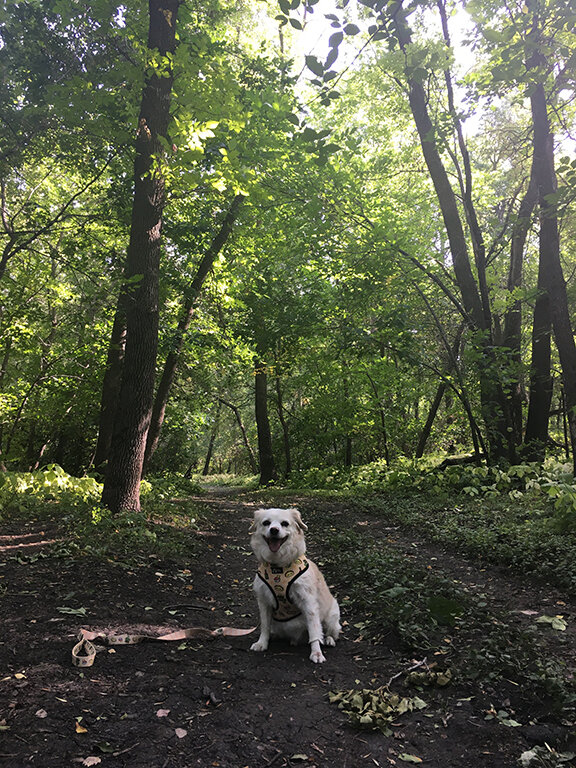
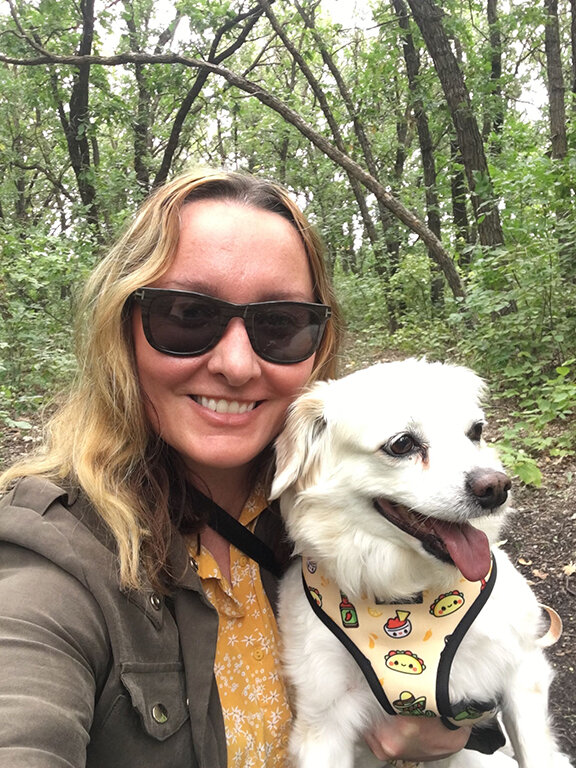
My ham, Monty, and I on one of our daily hikes. Monty’s taco fiesta harness and matching leash from Canadian company Blue Paw Co. Support local (©2020).

My ham, Monty, and I on one of our daily hikes. Monty’s taco fiesta harness and matching leash from Canadian company Blue Paw Co. Support local (©2020).

Time capsule portrait for 2020. Mask handmade in Canada from Econica. Support local (©2020).

Time capsule portrait for 2020. Mask handmade in Canada from Econica. Support local (©2020).

9,000

It’s been six months since I first heard of COVID-19. As was my ritual, I’d watch the evening news each night before heading to slumber and noted reports of a new, mysterious coronavirus identified in Wuhan, China. I didn’t pay it much attention, continuing to plan and book a holiday to Newfoundland that, in an alternate universe, I would soon be taking. Within a few weeks though, the tone and urgency of messaging changed and I understood the ramifications of human ignorance as cruise ships were left stranded at sea without port and countries called upon their military to help with the sheer volume of the dead.

Just six months later, updated daily death counts on the same newscast are normalized. It’s a strange detail to a strange reality. Even stranger is how little people seem affected by it. Whether through deliberate avoidance or willful denial, a large portion of the population doesn’t appear to be humbled by mass death. Meanwhile, I’m low-key drafting my will. I often wonder how this will be processed and reflected upon in the decades to come. I feel a major part of the discussion and dissertation will revolve around society’s dependency on the structures of capitalism rather than community and our subsequent increasing separation from the natural world.

As of this writing, there are just shy of 9,000 lives lost to COVID-19 in Canada (679,000+ worldwide). Those are nine-thousand people who have family and other loved ones mourning their loss. Nine-thousand individual stories of life that go beyond being a number on a counter. And that nine-thousand statistic includes people of all ages and socio-economic backgrounds. No one is immune. We don’t hear much of this. Of the plans, hopes and dreams cut short. A lot of what we see has been dehumanized by design, for detachment and convenience, but I personally feel it’s important to remember. Being thoughtful towards others, as well as mindful of your own mortality and the fragility of existence, is essential in times such as these. Empathy is a balm.

I’ve been thinking of my father a lot of late. In some ways, the world since his passing would be unrecognizable to him. In other ways, it would be similar in ways only he could truly understand. In his final months, one of my father’s favourite places to visit was IKEA because they had wheelchairs at the entrance available for those who might require them. Not those giant motorized scooters that seniors use to blaze down the aisles of Wal-Mart, but an actual wheelchair that would allow his daughter to walk with him in normal pace while window-shopping couches and bookshelves. While being pushed around an endless maze disguised as a furniture store doesn’t sound like a great time, this respite from cancer treatments and feeling part of society again, no matter how banal, was greatly welcomed. Most businesses and other public places did not make this consideration. Spending time with someone immunocompromised made me realize first-hand how little we, as a society, take into account the needs–physical, mental and emotional–of those with varying health conditions.

Which leads me to current recommendations by health officials to wear a mask in public spaces to help limit the spread of COVID-19 (and the unfortunate resistance of some that it is in violation of their “freedom”, as though one man’s rebellion to wear a small piece of fabric on his face is equivalent to the entire life and worth of someone else). It’s a simple measure that would help people like my father feel recognized, regarded and safe while trying to live during a time when added stress and uncertainty should be minimized. But it is also a small measure to help others as part of your community. Because any one of us may become part of the 9,000.