

To download a PDF of this poster (8.5”x11”), click here.

Plank the Curve
Covid-19 is rapidly changing our lives. Do your part to help plank the curve - stay at home and give adequate space to others during this unprecedented time. Together we can make things better for our community.
To download a PDF of this poster (8.5”x11”), click here.

Book Recommendations
Open Book
Written by Jessica Simpson
Pop culture in the early naughts was epic. It seemed like a more innocent time when we could all be scandalized by what Britney was up to, make questionable fashion (and romantic) choices without record of social media, and not be ashamed to hum “tell me why” to ourselves while grocery shopping. Seriously though, that song is timeless. While I was never really a fan of Jessica Simpson, I was looking forward to reliving my youth while reading the first of the pop star autobiographies of this era. This book definitely delivers and I was surprised by how candid it was about everything from abuse to addiction to having an emotional affair with Johnny Knoxville as her first marriage crumbled. The book also confirmed that my intuition is finely-tuned as I always suspected John Mayer was a dick.
Favourite line: “Get down the box from the top shelf of the emotional closet and marvel at the things that used to mean so much. The keepsakes of our mistakes, the souvenirs of lost years. But you know when to start making new memories with people who deserve the you that you are now.”
A Good Wife: Escaping the Life I Never Chose
Written by Samra Zafar
Arranged, sometimes forced, marriage is a foreign concept to most in the West. Acknowledging my own ignorance, up until a few years ago I didn’t realize it was still in practice. This autobiography details the high pressure and coercion faced by the author at the age of seventeen to marry a man she hadn’t previously met and the subsequent aftermath of years of abuse she endured all to maintain appearances in a community led by caste and societal interdependence. Her strength and perseverance win out at the end making this a tough read with a (thankfully) happy ending.
Favourite line: “But I’ve learned that diminishing my own fire does no one any service. I will get from my life what I feel I deserve. And if nothing else, I’ll be happier being myself than trying to fit into a box to satisfy others.”
Under the Banner of Heaven
Written by Jon Krakauer
This is the third book I’ve read by my new favourite author. The story and tone are different than his most famous works of individuals attempting to conquer the wild, but this is no less immersive a tale — the focus of Under the Banner of Heaven is the inception of the Mormon faith, its violent history across the landscape of an evolving nation, the belief that polygamy is the right of men, and how it all has influenced religious belief and zealots in the modern age. This is not a light read, but definitely one that will have you pondering the nature of religious belief.
Favourite line: “I was just on a quest,” he insists. “A quest to find the truth.”

Kill Your Idols
During a recent trip back to my hometown, my carry-on luggage brimmed with gifts including several bags of dried sardines for my dog that I half-expected to be questioned by airport security about (alas, any judgement on their behalf was reserved). For personal items, I always keep it strictly to the essentials of phone, wallet, keys and a book. A book for the wait. A book for the journey. Between this and a favourite playlist, any environment becomes instantly more enjoyable.
For this excursion, I wanted something light and a bit mindless as my energy and focus would be spent taking care of my mother and also at least three dozen sessions of fetch per day with my dog Monty. Taken from the shelves of my growing home library, I selected a book I acquired over a decade ago during a time when I was still enchanted by the mystique of the rock star and their extravagant lifestyle of excess. For those who watch the clock with a regular 9 to 5, reading about fame, wealth and unapologetic debauchery can allow our id to live vicariously through the antics of others. Also, as a woman, there is another psychological aspect to it; that innate attraction to a bad boy, of which I have been guilty. Whether sparked by Elvis’ gyrating hips or Michael Hutchence’s raw magnetism, there is something transfixing about a man on a stage singing a song potentially about you - at least in your own mind.
The book I selected though is one that now told a different story as I read it through the lens of maturity. ‘Let’s Spend the Night Together: Backstage Secrets of Rock Muses and Supergroupies’ (2007) by iconic groupie Pamela des Barres is a book I expect will never be republished as the contents of which would destroy the canonization we have built up around some of our idols.
It’s an explicit read.
I originally bought it for insight into the other side of the story that was being told in music biographies popular at the time. These were mostly written by (or about) men and narrated from a position of influence and ego. ‘Let’s Spend the Night Together’ was a different take with stories told by those whose admitted purpose was to “service the craft” rather than directly evolve it. Sex is involved, as is the currency of this particular muse, but reading between the lines to understand the culture behind it offers greater perspective on the changing mores of society (before and after), as well as the complexity of appreciating an artist’s body of work while remaining objective over their choices in life.
There is a chapter on Cassandra Peterson who started out as a Vegas showgirl and parlayed her talent into a career better known as Elvira, Mistress of the Dark. A section on the, erm, “art project” of Cynthia Plastercaster is particularly entertaining. As is the tale of Pleather, a rare male groupie. But other parts of the book spoke of lived experiences that weren’t as glamorous as they were illusory. In an era when women have opened up more about their experiences with men, of assault and abuse that are all too common, some of the stories shared in giddy detail are unintentionally depressing.
Lori Lightning—the most disturbing chapter of the book as she was known as a “baby groupie”—talks of having Jimmy Page of Led Zeppelin make her smoke entire packs of cigarettes until she would gag and had his entire tour crew complicit in hiding his illegal relationship with the teenager after the FBI started investigating. The author glosses over this instead focusing on how hurt and jealous she was when Page left her for Lori (rather than calling him out for statutory rape): “I wanted to blame her, but she was only thirteen-years-old.”
It’s hard not to compare to my own life of suburbia on the Canadian prairies, where the driving force of my middle school existence was to level up on Super Mario World.
The aforementioned Cynthia Plastercaster was so distraught from her experience with other members of Led Zeppelin that she refused to talk about it, beyond describing feeling “used and abused”.
And there’s a lot of Iggy Pop, including this story from Dayna of the Texas Blondes contingent: “I was with Iggy Pop for awhile … I was very young when he took me on tour, and finally his manager said, ‘You cannot be dragging a fourteen-year-old girl across state lines’ … I look back and think ‘What a pedophile!’.
I haven’t bothered to comment on the antics of those no longer with us.
A once thought-to-be light read instead got me rethinking my relationship with music, with whom I appreciate and place on pedestal, with how different stories—and different perspectives—change the narrative and legend of any one person’s life. During the past five years, tales such as these would have have resulted in public shaming and the probable demise of career (in their time, they felt accepted … and even encouraged). But music seems somewhat untouchable for the cultural conversation. We do not reflect on these instances in the same light that we do, say, Roman Polanski, Woody Allen or Harvey Weinstein. Unlike a film, music weaves through our life on a much more personal level which might be the reason we don’t confront the concept of our idols in the same way. Even though we should.
When I was finished, I placed the book back on its shelf to wait and see how it would read in another decade.

Iggy Pop pictured with Lori Lightning.

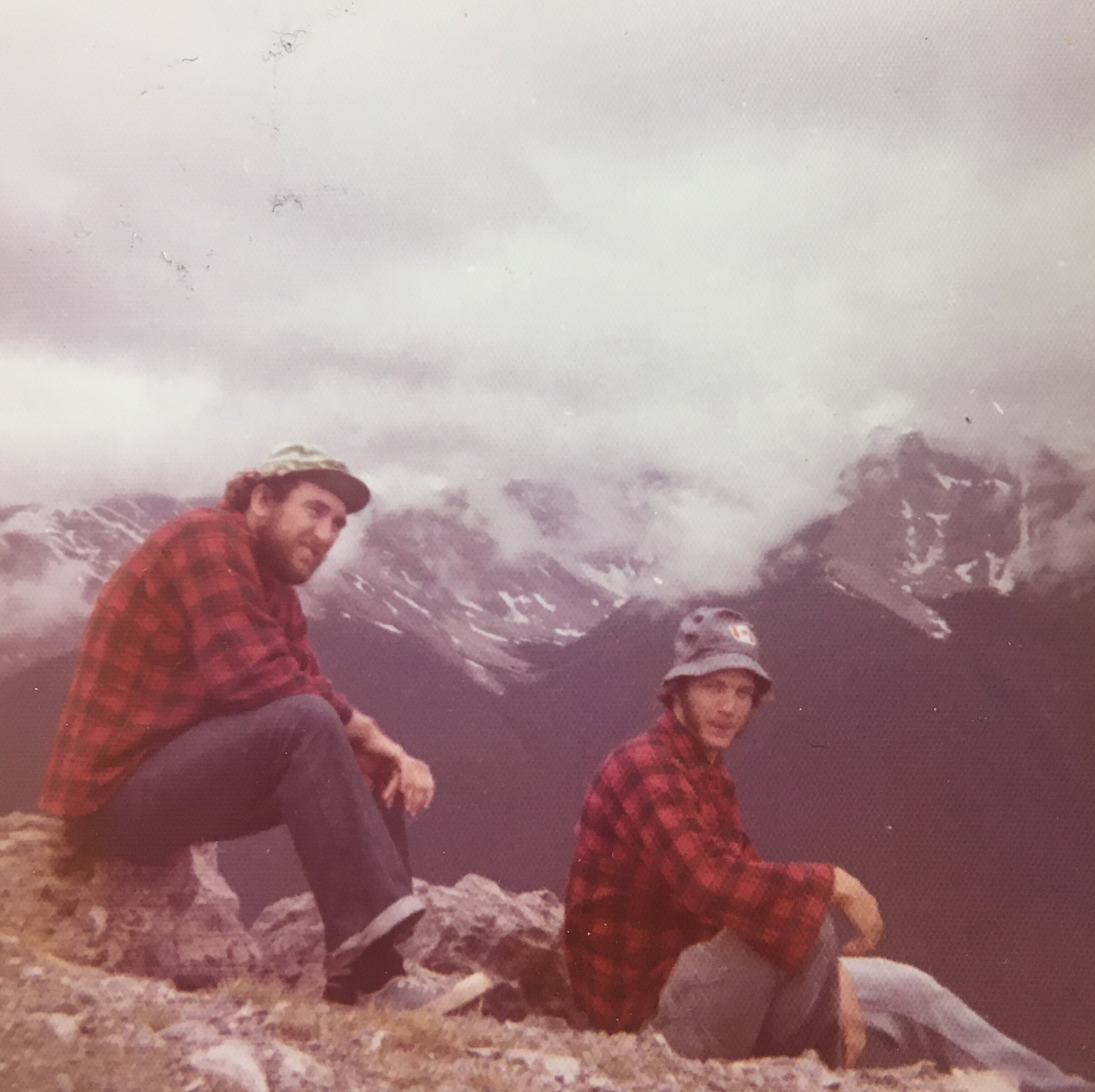
My father at the start of his cycling adventure spanning four provinces in western Canada (©Deborah Clague).
Into The Wild
Stories about disappearance and protagonists who seek an alternate purpose in life beyond what society prescribes have always intrigued me. I live through the words on the page, imagining myself in their shoes and being brave enough to live without the comfort of predictability. I daydream of a life unbound.
In his youth, my father exhibited this carefree spirit and I feel some of his determination to tread his own path runs through my blood as well. In the seventies, before this became commercialized by the tourism industry, my father and two of his friends got on their 10-speed bikes and peddled from Winnipeg to the west coast camping on the side of the road or in forests shadowed by the Canadian Rockies. When he’d tell me stories about the adventure, about the physical hardship, the encounters with wildlife—including a pack of curious wolves that trailed them for a bit down the Icefields Parkway near Jasper—and the connection to nature that he experienced, I sat in awe. I could sense the feeling of accomplishment and fulfillment emanating off him and longed to lead a life where I could feel the same sense of purpose, if only briefly.

Living off radar for a bit can be incredibly recharging. I’ve experienced this on an elementary level during my solo travels but these have only been a few weeks at a time (and, sadly, never as disconnected as I probably need). Traveling to a new world, one in which I don’t understand the custom or language, forces me to be present, receptive and sharp. Being reliant solely upon my faith in the affability of strangers and the power of my intuition connects me to a deeper sense of humanity and realization of my own strength. But even on these escapades, I am still safely ensconced in a metropolis built for the comfort of man. The older I get, the more I (like my father) want a challenge and to reconnect with nature.
A few months ago, a book I read made me tumble into a deep rabbit hole of exploration on this pipe dream and people who were brave enough to choose an unconventional path in life. “Into Thin Air” by author/mountaineer Jon Krakauer is one of the most riveting, well-crafted works of non-fiction I have ever read in my life. So awestruck was I by his tale of climbing Mount Everest that I started researching my own possible adventure in the Himalayas and immediately went out to buy as many of his other works as I could. This included the work he is perhaps most known for - “Into The Wild”.
Since that book’s release, the story of Chris McCandless has become legendary; although his legacy is polarizing. Leaving his home, family and life savings in pursuit of the open road and a life far removed from capitalism and other societal constructs, Chris lived his dream while navigating the United States in pursuit of deeper meaning in life. Based on the journals and connections he left behind, it appeared he found it in places as varied as Arizona, South Dakota and, the place he perished, Alaska. His tale had an abrupt, heartbreaking end that some critics say underlines his naïveté. But another camp of idealistic dreamers has elevated him to myth-like status, making the backcountry of the 49th state, in particular the location of Bus no.142, a spot for pilgrimage. “Into the Wild” is a short book with a big impact detailing his brief, albeit well-lived, life.
If we live a life where we only see few things, visit few places, and meet few people, we pass through existence having only covered a few measures of distance - but to live a life well lived, with many perspectives and experiences, is to touch upon every part of the tapestry of what it means to be human. As I enter a new decade, I no longer aim to be the girl with the most cake. Instead, I crave authenticity. I search for meaning in script and the stars. In that regard, I admire Chris McCandless for his rejection of what society has become and his pursuit of his own destiny. We should all be so lucky to realize our purpose.
“Don’t settle down and sit in one place. Move around, be nomadic, make each day a new horizon. “



❤️
My heart breaks for the people and wildlife affected by the Australian fires. We only have one planet and it is clear we need to change our ways to ensure its beauty and wonder thrive for millennia to come.
We love you, Australia.

SoGood
I’m excited to judge the RGD 2020 SoGood Awards, which celebrates the power of design to do good! Submissions are any communications design projects that help to incite positive action in our communities and make meaningful changes in how we live our lives.
Applicants should submit their work by February 14, 2020 to be considered. Click here for more information.

The Decade: Loss
The last decade of my life was punctuated with loss. In the span of four years, I lost both of my maternal grandparents, a pet that I cherished, and - the hardest, deepest - my beloved father who passed away months after being unexpectedly diagnosed with terminal cancer. Processing the finality of these events has not been easy and has left me with an emptiness that occasionally wanes but is always present. I try to work with it. I’ve tried to appease it by feeding it stimulation and adventure. I’ve tried to kill it with carbs and boys. I now just treat it as a part of me. Less a burden and more a facet of experience that can influence and direct my path forward towards the life I want to live.
You may never know the last time you get to spend with someone.
Cherish every moment.
Be generous with love.
This is the most important wisdom I gained over the past decade.
The Decade: The Climb
The most physically demanding thing I achieved over the past decade was climbing an actual mountain. At 3,776 metres, it wasn’t anywhere near the scale of, say, Everest (which is 8,848 metres) but for someone who’d rather eat doughnuts than hit the gym, this accomplishment was monumental. I did it for a very special reason - a demonstration of my deep love for my father and a promise to him on how I would fill my days with adventure in remembrance of his spirit.
I’m a person of my word.
To read more about climbing Mount Fuji, click here, here, here, here and here (or search the Japan tag for a travelogue on my other experiences in the land of the rising sun).

I made it! - the summit of Mount Fuji (©Deborah Clague, 2015).

Climbing Mount Fuji (©Deborah Clague, 2015).

Climbing Mount Fuji (©Deborah Clague, 2015).

The terrain on the path heading up was quite rocky and not that easy to traverse at 3:00am on limited sleep (©Deborah Clague, 2015).

The path returning to the bottom was different terrain but equally as hard as reaching the summit. The volcanic ash made it slippery and hard to establish grip (©Deborah Clague, 2015).
The Decade: The Amateur Chef
Growing up, my relationship with food was much different than it is today. Food’s primary purpose was fuel, a means to garner the energy that youth required. It was also pretty routine and safe. My homemaker mom had a few specialties that she seemed to rotate on a weekly basis. This included well-cooked pork chops with a pinch of black pepper, Prego-drenched spaghetti and, my favourite, chicken fingers and fries (being from Winnipeg, I’ve also eaten my weight in pirogies several times over). Food was not an indulgence in my childhood home. Meals were not made from scratch but rather selected for convenience. Up until a few years ago, this was my outlook as well.
The kitchen in my home is bigger than I’d ever had before. The large island just beckons to be put to use, although for a long time it was neglected to the role of storage space for paperwork and other random items. I would occasionally attempt baking something easy but nothing of intricacy. My desire to truly become a gastronomy student was instilled by my partner. One of our first dates was dinner at an Indian restaurant. He was excited to introduce me to biriyani, a rice dish heavy with spices and mixed with assorted meats. My experience with Indian food was minimal up until that point and I was admittedly concerned about the effect it would have on my limited-palate stomach. I approached it slowly, taking small spoonfuls … until I couldn’t stop. The flavour was so rich. It opened my eyes to a whole new world. Biriyani has also become my favourite food. I like it more than pizza - which is really testament to how delicious it is.
Now I take a great pleasure in not only eating but the entire process of cooking from researching new recipes to learning what umami is. When I travel, I am most excited about leisurely exploring the grocery stores and markets for spices and other ingredients not readily available at home. My creative flair is now being applied to cuisine as both hobby and art form. My waistline may be expanding but my overall health and enjoyment in life has never been better.

Cooking at an apartment in Paris (©2019, Deborah Clague).

Bison kebab with homemade tzatziki (©Deborah Clague, 2017).
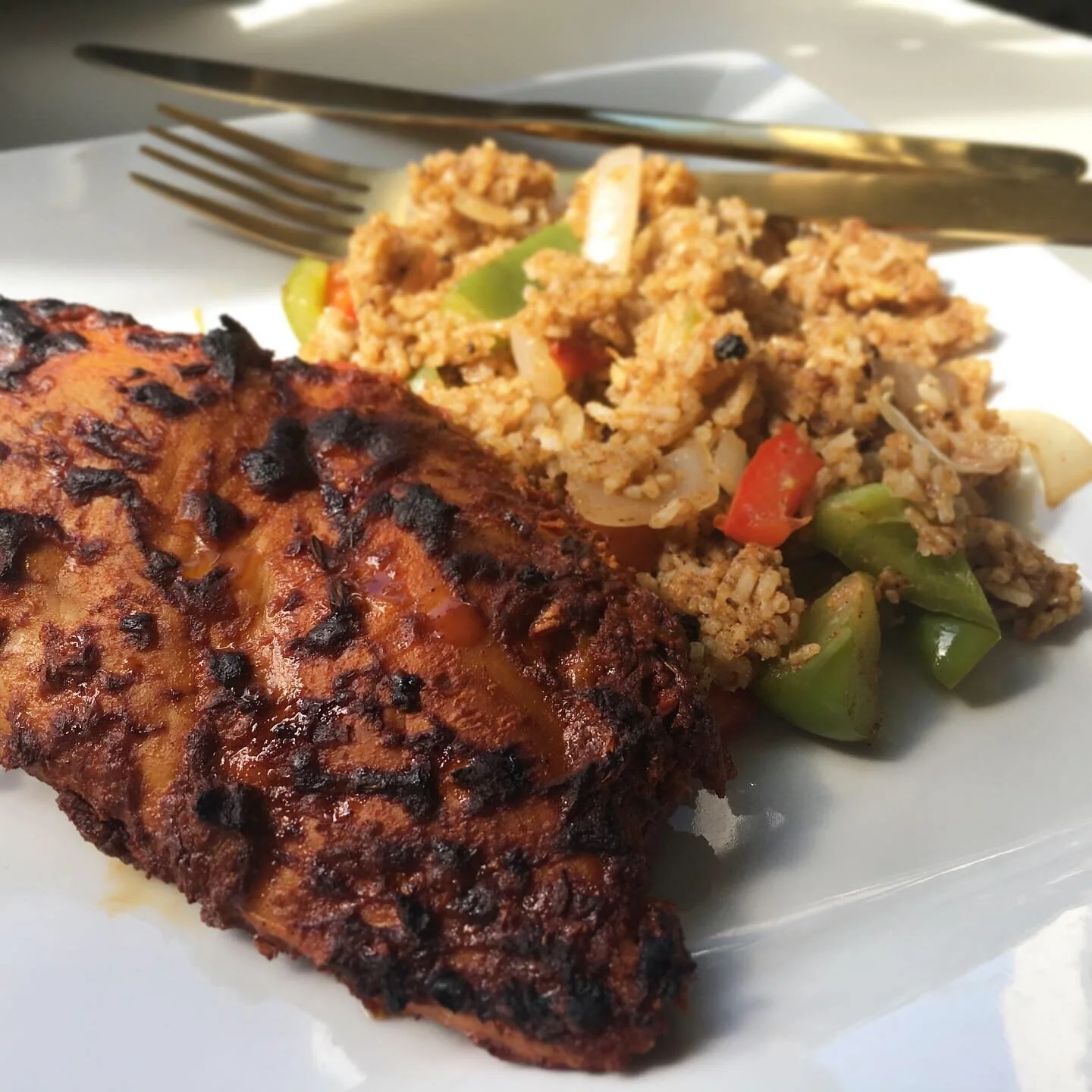
Tandoori chicken with biriyani (©2019, Deborah Clague).

Lemon-garlic-rosemary chicken with black rice and vegetables (©2019, Deborah Clague).